
Articles, Executive Guides, Assessments, Insights
Executive Security Resources
Practical guides designed to help executives, security leaders, and decision-makers evaluate and strengthen their security programs.
Executive Guide to Security Governance
Why Strong Security Programs Require More Than Good Operations
Many organizations focus heavily on security operations while overlooking the governance structures that drive accountability, consistency, performance measurement, and continuous improvement.
Includes:
✓ Governance Fundamentals
✓ Security Program Maturity Model
✓ Executive Self-Assessment
✓ Common Governance Gaps
The Security Governance Maturity Model™
A Framework for Evaluating Physical Security Program Effectiveness
White Paper
This white paper introduces the Security Governance Maturity Model™, a framework designed to help organizations evaluate governance maturity, identify improvement opportunities, and strengthen accountability, risk management, operational consistency, and organizational resilience.
MJG Governance Insights™
Receive monthly executive insights on security governance, accountability, risk management, and organizational resilience.
"Assess Your Security Governance Maturity"
HSOS™ Security Governance Maturity Assessment
A complimentary self-assessment tool designed to help organizations evaluate governance maturity, operational accountability, documentation practices, and leadership oversight.
PDF Download
UNDERSTANDING KEY PERFORMANCE INDICATORS (KPIs)
A Practical Guide for Security Operations
Prepared By:
MJG Consulting Group LLC
WHAT IS A KPI?
KPI stands for:
Key Performance Indicator
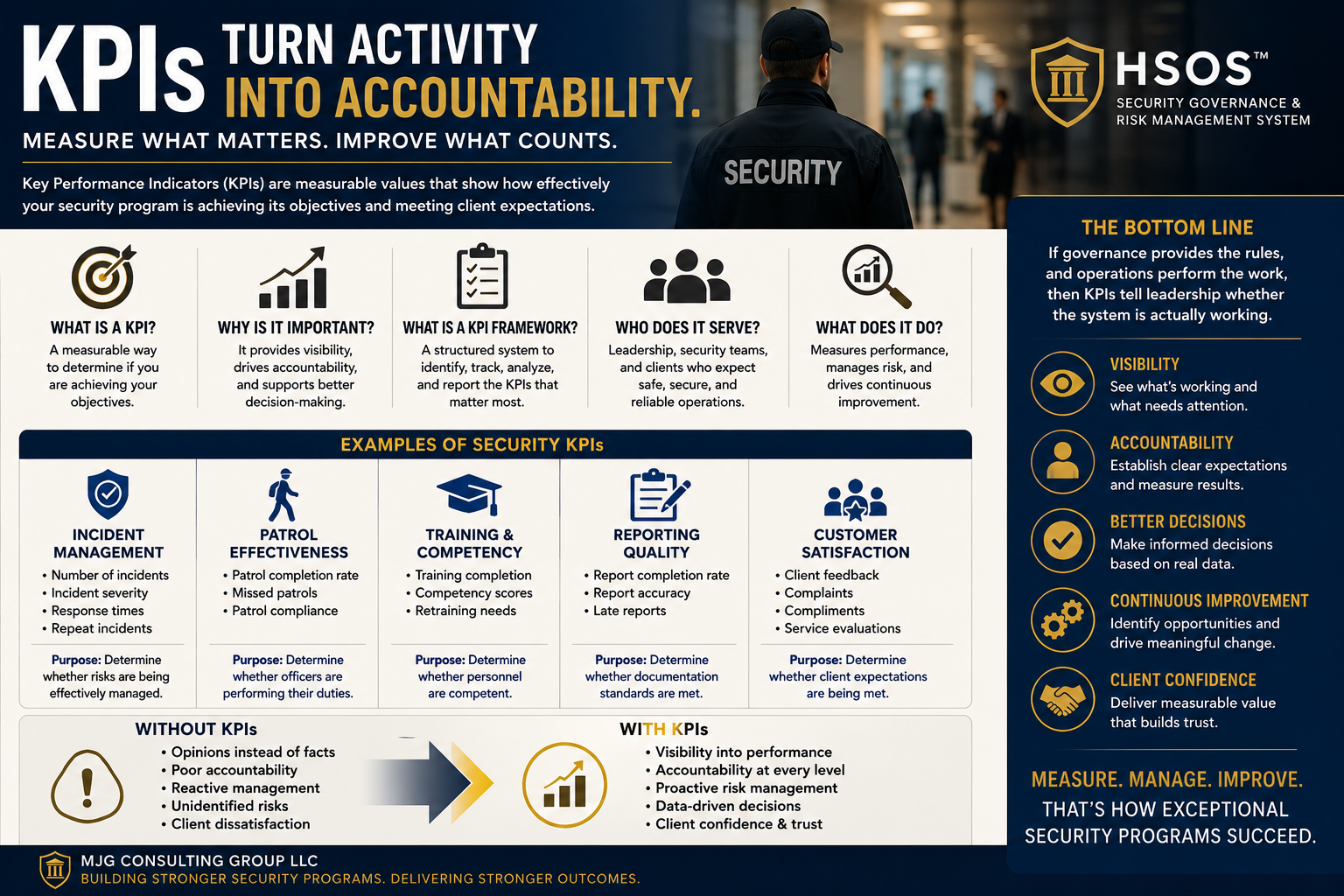
A KPI is simply a measurable way to determine whether a person, department, process, or organization is achieving its intended objectives.
In plain English:
A KPI tells you if you're succeeding or failing.
Without KPIs, leaders are forced to rely on opinions, assumptions, and gut feelings.
With KPIs, leaders can make decisions based on facts and measurable results.
A SIMPLE EXAMPLE
Imagine you own a restaurant.
You might ask:
Are customers satisfied?
Are employees showing up on time?
Is food quality consistent?
You could guess.
Or you could measure:
Customer satisfaction scores
Employee attendance rates
Number of customer complaints
Those measurements become KPIs.
Security programs work exactly the same way.
WHY ARE KPIs IMPORTANT?
Many organizations measure what security personnel do.
Few measure whether those activities actually produce results.
For example:
Activity
Officers conducted patrols.
Performance
Did patrols reduce incidents?
Activity
Training was completed.
Performance
Did competency improve?
Activity
Reports were submitted.
Performance
Were incidents resolved effectively?
KPIs focus on outcomes rather than activities.
WHAT IS A KPI FRAMEWORK?
A KPI Framework is a structured system used to identify, track, analyze, and report performance indicators.
Think of it as:
The Security Program Report Card
It provides leadership with visibility into:
Performance
Accountability
Trends
Risks
Opportunities for improvement
WHAT DOES A KPI FRAMEWORK ANSWER?
A properly designed KPI framework helps answer questions such as:
Operations
Are security officers performing effectively?
Training
Is training producing competent personnel?
Risk
Are security risks increasing or decreasing?
Service
Are client expectations being met?
Leadership
Are supervisors managing effectively?
Compliance
Are procedures being followed?
SECURITY KPI EXAMPLES
Incident Management
Measure:
Number of incidents
Incident severity
Response times
Repeat incidents
Purpose:
Determine whether security risks are being effectively managed.
Patrol Effectiveness
Measure:
Patrol completion rates
Missed patrols
Patrol compliance
Purpose:
Determine whether officers are performing required duties.
Training & Competency
Measure:
Training completion rates
Competency assessment scores
Retraining requirements
Purpose:
Determine whether personnel possess required knowledge and skills.
Reporting Quality
Measure
Report completion rate
Report accuracy
Late reports
Purpose:
Determine whether documentation standards are being maintained.
Customer Satisfaction
Measure
Client feedback
Complaint
Compliments
Service Evaluations
Purpose:
Determine whether security services meet client expectations.
CLIENT-FOCUSED KPIs
Many clients care less about security activities and more about outcomes.
Clients often want answers to questions such as:
Are my guests safe?
Are my employees safe?
Are incidents decreasing?
Is security visible and professional?
Are officers responding quickly?
Is the security team reducing liability?
A KPI framework helps answer those questions.
WHAT HAPPENS WITHOUT KPIs?
Without KPIs, organizations often experience:
Poor accountability
Inconsistent performance
Reactive management
Unidentified risks
Lack of leadership visibility
Difficulty justifying budgets
Client dissatisfaction
Leaders simply do not know what is working and what is not.
WHAT HAPPENS WITH KPIs?
Organizations gain:
Visibility
Leaders can see performance trends.
Accountability
Personnel understand expectations.
Better Decision-Making
Decisions are based on measurable data.
Continuous Improvement
Weaknesses can be identified and corrected.
Client Confidence
Clients receive evidence that security services are performing effectively.
A PRACTICAL EXAMPLE
Imagine a security manager reports:
"My officers are doing a great job."
That statement is an opinion.
Now imagine the manager reports:
98% patrol completion rate
100% training compliance
22% reduction in incidents
Average response time under 3 minutes
95% client satisfaction score
Those are KPIs.
Those are facts.
And facts provide confidence.
THE HSOS APPROACH
Within the HSOS Security Governance & Risk Management System, KPIs are used to:
Measure performance
Evaluate effectiveness
Improve accountability
Identify trends
Support decision-making
Drive continuous improvement
The goal is not to collect data.
The goal is to use meaningful data to improve security operations and achieve organizational objectives.
FINAL THOUGHT
A security program cannot improve what it does not measure.
KPIs provide the visibility necessary to understand performance, manage risk, meet client expectations, and continuously improve operations.
In simple terms:
If governance provides the rules, and operations perform the work, then KPIs tell leadership whether the system is actually working.